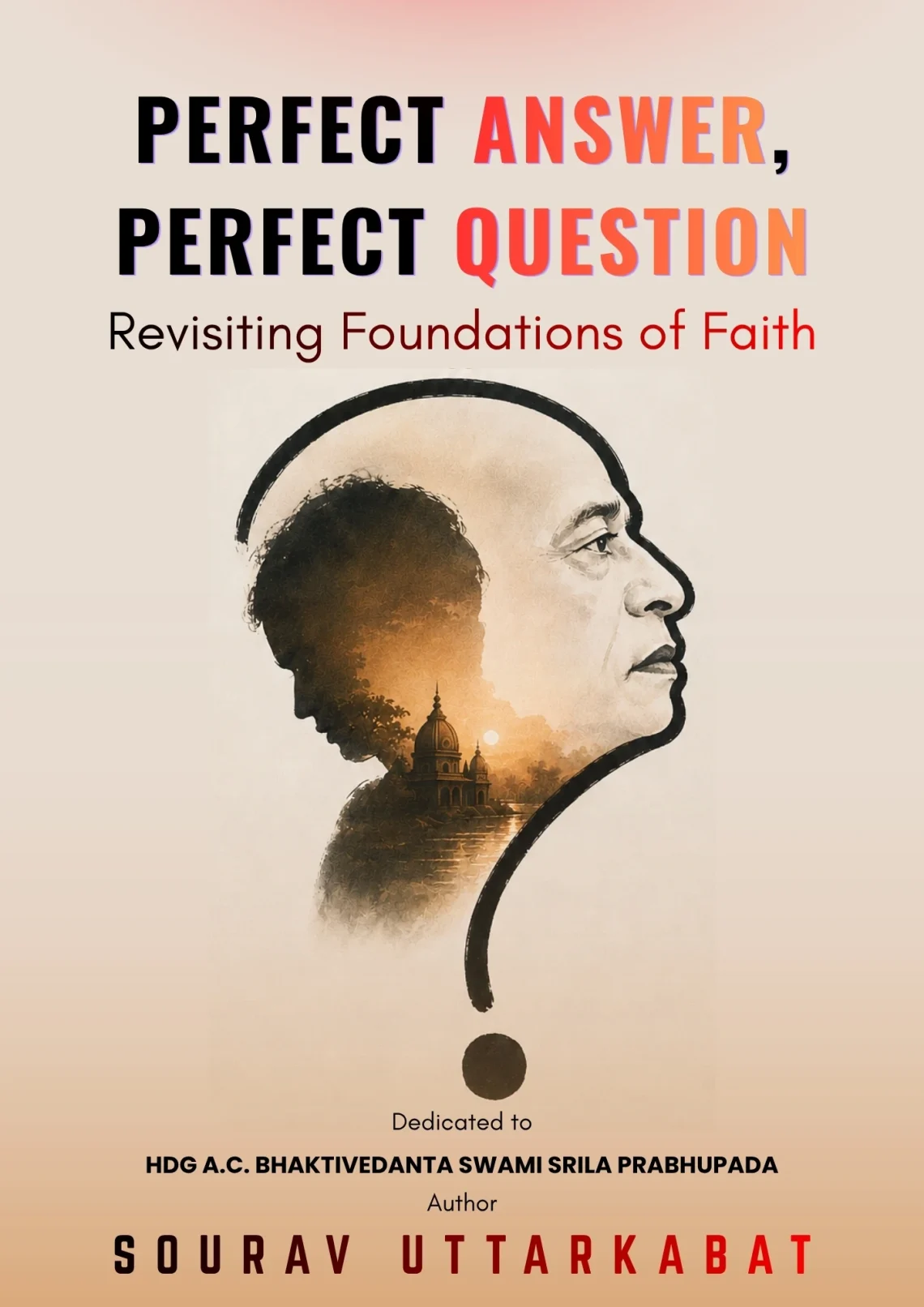
Review of Perfect Answer, Perfect Question
by bhakta Eric Johanson
This book traces the journey of one ISKCON institution devotee away from Krishna consciousness. The author details his various explorations into cult psychology, the history of Krishna consciousness, as well as the psychology of religion, all in his search for objective evidence. Of particular concern is the tendency of human beings to gravitate towards a worldview centered on certainty, something apparently provided by virtually all religions. In the end the author, one Sourav Uttarkabat, concludes that the most reliable process of acquiring evidence is that of uncertain, empirical scientific observation, this despite praising the Krishna conscious philosophy “as the best and most beautiful theology made by mankind ever.(p256)” For him the authority of the philosophy ends up losing out to the empiricism of mundane science.
Now although the book is impressive in it’s almost PhD. level of research and breadth, what to speak of its exhaustive introspection, what seems like an obvious observation is conspicuous by its absence. And that is that science, in our lifetimes, is not going to provide answers to the big questions generally answered by religion. This means that one truly interested in getting good answers to “Who am I?,” etc. is going to have to accept some metaphysical authority and hope they make the correct choice. Hence the value of “the best and most beautiful theology made by mankind ever.(p256)” Our existential position is, after all, much like a general during war – one’s decisions have to be made using the best information available – death makes us unable to wait for the complete, full answers.
Perhaps the author is so committed to his personal sovereignty that he is planning to face the unknowns of empiric knowledge alone and with courage. I know one atheist who regularly practices beating back any hope of life after death, and the author now places himself about 70% towards that extreme. Or perhaps he’ll end up writing a sequel.
Institutionalized
Anyway, of particular interest are the steps that took this apparently one-time fully committed devotee away from the practice of Krishna consciousness. The management of the ISKCON institution (International Society for Krishna Consciousness) plays a central role in the second phase of the author’s inquiries. His initial confusion came over the various explanations for the origin of the jiva – either the spiritual world or somewhere else. He couldn’t understand why such a central point of the philosophy would have competing answers and authorities.
Now since the ISKCON institution is allegedly Srila Prabhupada’s movement, it is surprising that he wasn’t answered unequivocally with Srila Prabhupada’s conclusion on the matter:
“As living spiritual souls we are all originally Krishna conscious entities.” Purport, Hare Krishna maha mantra, Original Hare Krsna record album
“Regarding your questions about how and from where did the conditioned souls fall, your first question if someone has a relationship with Lord Krsna on Krsnaloka, does he ever fall down? The souls are endowed with minute independence as part of their nature and this minute independence may be utilized rightly or wrongly at any time, so there is always the chance of falling down by misuse of one’s independence. But those who are firmly fixed up in devotional service to Krsna are making proper use of their independence and so they do not fall down.
Regarding your second question, have the conditioned souls ever seen Krsna? Were they with the Lord before being conditioned by the desire to lord it over material nature? Yes, the conditioned souls are parts and parcels of the Lord and thus they were with Krsna before being conditioned. Just as the child must have seen his father because the father places the child in the womb of the mother, similarly each soul has seen Krsna or the Supreme Father. But at that time the conditioned souls are resting in the condition called susupti which is exactly deep sleep without dream, or anesthetized state, therefore they do not remember being with Krsna when they wake up in the material world and become engaged in material affairs. I hope this will satisfy your questions.” Letter to Jagadisha, LA, April 25, 1970
These clear statements coming from the sampradaya acarya, the obvious successor to Srila Bhaktisiddhanta Sarasvati Prabhupada in the Gaudiya Vaishnava parampara, should have cleared up any doubts on the matter. Why the author was not given this authoritative answer is hard to understand.
The author’s deeper question, however, became whether he could trust his major life decisions to leadership such as provided by the ISKCON institution. The answer he comes to after much research and deliberation is a definitive no. And this is after years spent serving and defending that leadership. Now, in this regard, although most of the institution’s major controversies, such as the child abuse, are listed and described, it isn’t their particulars that force the author’s conclusion, but rather the institution’s patterns of handling them. Two are described:
“Across multiple controversies discussed in earlier chapters, critics have argued that initial responses often focused on minimizing public damage, avoiding scandal, controlling information, discouraging external scrutiny, or protecting the movement’s image. . . . . Members begin asking not only whether a particular allegation is true, but whether concerns can be raised safely at all. (p64)”
“Many controversies appear to follow a similar trajectory. Initial complaints are disputed, minimized, ignored, internally managed, or treated as isolated incidents. As additional complaints emerge, pressure gradually increases. Eventually the issue reaches a threshold where external attention becomes difficult to avoid. (p64)”
This also comes up later:
“One of the simplest tests of any institution is how it responds to criticism. I noticed that criticism was often answered by examining the critic rather than the claim. . . . . The question was not whether critics were trustworthy, but whether criticism was being evaluated on its merits or dismissed because of its source. (p84)”
In the next section the author describes the institution’s parallels with the cult psychology described in various academic studies. In a sub-section he calls “Epistemic Gaslighting” the author sums up his pressured, anxiety-driven state of mind in the institution:
“I gradually felt trapped in a strange loop. Whenever my conclusions agreed with authority, my reasoning seemed acceptable. Whenever my conclusions disagreed with authority, my reasoning suddenly became evidence of immaturity, conditioning, pride, or illusion. (p111)”
At the book’s end the author summarizes his study of the ISKCON institution:
“I found non-trivial compromises in conduct and management, but still, I was a defender to outer critics. But when I found the institution’s attitude faulty – that instead of trying to eliminate misconduct, it lives through misconduct and acts as a parasite body (that intends to harm the body it takes shelter of) – my perspective changed. (p259)”
The meaning of the word acarya is “one who teaches by example.” The example of the ISKCON institution described by the author clearly isn’t very good, and this is after decades of relative improvement up from the low point of the zonal acarya era. People who come and surrender their lives are still being exploited and psychologically manipulated (abused).
The leadership is still primarily concerned with its own benefit. This remains a constant that is reflected in the high turnover rate of rank-and-file devotees, all with some variation of the author’s account. We are now in the third generation of ordinary devotees who have come to the institution and experienced much the same from the leadership; this third being people of Indian, Hindu descent. The first was Srila Prabhupada’s personal initiates, and the second the followers of the zonal acaryas. Very little of these first two survived the hypocrisy, personal dealings and heavy-handedness of the leadership.
The underlying principle thus remains the same – devotees are encouraged to discriminate on the basis of the Krishna consciousness philosophy, except when examining the leadership. Then one is supposed to ignore what they see and think, often out of fear of committing offences. This selective application, or misapplication, of proper discrimination is just another, extremely pernicious form of material conditioning. One is being trained to ignore truth, the antithesis of how a genuine brahmana thinks. In this way, modern devotees are being conditioned to ignore the philosophy, something that is part and parcel of the mode of ignorance. In other words, today’s devotees are still being trained to become yes-men and yes-women, sudras, all in the name of the highest, absolute philosophy. The reason it’s so pernicious is because this degradation is being done under the guise of spiritual elevation and awareness.
This sort of pretense, when it is found out, usually results in anger and disappointment for the victims. This author, however, exhibits good control of his anger, as shown by its absence from the book. Nevertheless, seeing through the façade of the ISKCON institution is hardly a promotion for it, and this realization only encourages the author to question further, eventually bringing him to give up Krishna consciousness altogether.
Spiritual pretense is a symptom of faithlessness in that the leadership thinks they can get away with their duplicity or manipulation and abuse with no consequences. If anything, however, according to Srila Prabhupada the leaders are expected to be on that much higher a standard regarding those consequences. Here is something he said about the members of the GBC (Governing Body Commission).
“So Vidura was Yamarāja. Not only he was Yamarāja, ordinary, but he is one of the great authorities. There are twelve authorities mentioned in the śāstra. One of them is Yamarāja. Balir vaiyāsakir vayam. This is stated in the Śrīmad-Bhāgavatam. Yamarāja is one of the GBC of Krishna. Yes. As we have got twelve GBC’s, similarly Krishna has got GBC’s. Now,
svayambhūr nāradaḥ śambhuḥ kumāraḥ kapilo manuḥ prahlādo janako bhīṣmo balir vaiyāsakir vayam (SB 6.3.20)
That twelve men are authorized to preach Krishna consciousness. So we have to follow. Mahājano yena gataḥ sa panthāḥ (Cc. Madhya 17.186) Therefore we have created these GBC. So they should be very responsible men. Otherwise, they will be punished. They will be punished to become a śūdra. Although Yamarāja is a GBC, but he made a little mistake. He was punished to become a śūdra. So those who are GBC’s, they should be very, very careful to administer the business of ISKCON. Otherwise they will be punished. As the post is very great, similarly, the punishment is also very great. That is the difficulty. You can see from this example, Vidura. He was immediately punished. He did little mistake at Maṇḍūka… Because the ṛṣis, the munis, they will curse. Dealing is very… Even Yamarāja is not taking.” Lecture on Srimad Bhagavatam 1.13.15, Geneva, June 4, 1974
So much for the responsibility being dutifully carried out. Anyway, such faithlessness is contagious, much like a drunkard father who tells his children not to drink. It’s the example of the father or the faithlessness of the leaders that really gets passed down to the followers; and the many generations of departed devotees are the result that the leadership must be judged by. And this author’s book is just one of the latest examples.
Not thinking that there will be a reaction for abusing others is also a symptom of atheism in that one doesn’t think there is a higher control that will administer punishment. One can rightly ask if this mentality wasn’t passed on to the author from the leaders of the ISKCON institutional organized religion.
“The church that has the best chance of survival in this damned world is that of atheism under the convenient guise of theism. The churches have always proved the staunchest upholders of the grossest form of worldliness, from which even the worst of non-ecclesiastical criminals are found to recoil. . . . The idea of an organized church, in an intelligible form, indeed marks the close of the living spiritual movement. The great ecclesiastical establishments are the dikes and the dams to retain the current that cannot be held by any such contrivances. They, indeed, indicate a desire on the part of the masses to exploit a spiritual movement for their own purpose. They also unmistakably indicate the end of the absolute and unconventional guidance of the bona fide spiritual teacher. . . . Those are, therefore, greatly mistaken who are disposed to look forward to the amelioration of the worldly state–in any worldly sense–from the worldly success of any really spiritual movement. It is these worldly expectants who become the patrons of the mischievous race of the pseudo-teachers of religion, the Putanas, whose congenial function is to stifle the theistic disposition at the very moment of its suspected appearance. But the real theistic disposition can never be stifled by the efforts of those Putanas. The Putanas have power only over the atheist. It is a thankless, but salutary, task which they perform for the benefit of their unwilling victims.” Srila Bhaktisiddhanta Sarasvati Goswami Prabhupada, Putana (Organized Religion), The Harmonist, January 1932 edition
Sa eva go-kharaḥ?
What is perhaps a key turning point for the author’s convictions is found in this quote concerning his, a conditioned soul’s, tendency to be illusioned:
“If my perception is fundamentally unreliable, how did I determine that a particular authority was trustworthy? If my intelligence is fundamentally unreliable, how did I reason my way into accepting a philosophy in the first place? If my reasoning cannot be trusted when it produces uncomfortable conclusions, why was it trusted when it produced desirable conclusions? (p111)”
Through the course of the book the author progresses from somewhat strong faith in Krishna consciousness to a point he describes as 70% of the way from theism to atheism. His above doubts apparently end up flipping his convictions a full 180 degrees, his current position being characterized by firm attachment to the mundane scientific method. He pretty much states that he is now doubtful that God and spirit souls exist. In other words, he has now concluded that he probably is his material body.
yasyātma-buddhiḥ kuṇape tri-dhātuke
sva-dhīḥ kalatrādiṣu bhauma ijya-dhīḥ
yat-tīrtha-buddhiḥ salile na karhicij
janeṣv abhijñeṣu sa eva go-kharaḥ
“A human being who identifies the body made of three elements as the self, who considers the by-products of the body to be his kinsmen, who considers the land of his birth worshipable, and who goes to a place of pilgrimage simply to bathe rather than to meet men of transcendental knowledge there, is to be considered like a cow or an ass.” Śrīmad-Bhāgavatam 10.84.13
Now conviction or belief, especially in spirituality, is a pretty fluid thing. The strongest convictions would come from direct realization or revelation. Weaker would come from the social, familial or psychological. Since the author devotes an entire section to the psychology of religion, we can probably assume that this academic content had significant influence on his thinking. Throughout the book the author discusses his struggle with the need for certainty, something he says was amply provided by Krishna consciousness.
So religion certainly provides definite answers to life’s big unknowns. It also provides structure to one’s life and a social network, what to speak of a perfect, idealized relationship with an all-powerful, all-knowing infinite being, as well as fulfilling so many of the other psychological needs that the author cites from psychological and other academic sources. God is said to be an ideal psychological safe haven and secure base. Of particular note is 17th century philosopher Blaise Pascal’s proposition, Pascal’s wager: “if God exists and you believe, the reward may be infinite; if God does not exist, little is lost. (p241)” This or its various permutations certainly provides psychological comfort to most believers. Anyway, all religions pretty much fulfill these needs, but they also largely disagree with each other.
I dare say most devotees’ convictions are probably based on fulfilling these very same psychological needs. In fact the drive for certainty seems to be what allows more dysfunctional devotees to play God, or at least God’s mouthpiece, to those unfortunate enough to submit to them. This disease is, however, hardly unique to Krishna consciousness, although Krishna consciousness has certainly shown us some of recent history’s worst examples.
One of the best features of the author’s analysis, however, is his emphasis on knowing the truth or finding evidence of truth. Whatever one’s convictions are, they should be based on this, and this is ultimately the direction any progressive soul needs to chart their course. I wish the author well, as well as you, dear reader. Here is the means to attain realization of the truth:
“The three words, namely Hara, Krsna and Rama, are transcendental seeds of the maha-mantra, and the chanting is a spiritual call for the Lord and His internal energy, Hara, for giving protection to the conditioned soul. The chanting is exactly like a genuine cry by the child for the mother. Mother Hara helps in achieving the grace of the supreme father, Hari, or Krsna, and the Lord reveals Himself to such a sincere devotee. No other means, therefore, of spiritual realization is as effective in this age, as chanting the maha-mantra: Hare Krishna, Hare Krishna, Krishna Krishna, Hare Hare, Hare Rama, Hare Rama, Rama Rama, Hare Hare.” Purport, Hare Krishna maha mantra


You May Also Like

The Greater Krishna Consciousness Movement Part 2 of 4

ISKCON, ISKCON 2.0 and Beyond, Eunuch “Gurus” and What Comes After. Part 5 of 5
