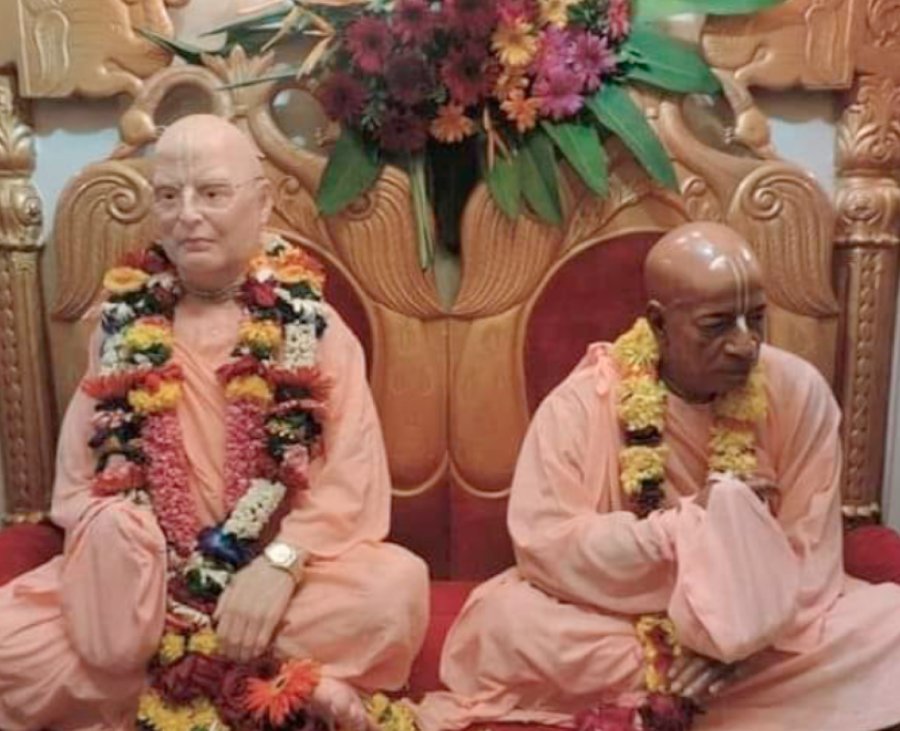
Kirtanananda – A Study in Duplicity and Depravity
As referenced in Henry Doktorski’s Gold, Guns and God Vols. 1-10, a biography of Kirtanananda and history of his New Vrindavana community.
by bhakta Eric Johanson
“Namno balad yasya hi papa-buddhih. If one thinks that ‘I am chanting Hare Krishna mantra, so my sinful resultant actions are now nullified. Now again let me do it. Again I shall nullify.’ This is greatest offense.” Lecture on Bhagavad-gita 4.10, Bombay, March 30, 1974
The followers of Srila A.C. Bhaktivedanta Swami Prabhupada have produced at least two types of cheater “gurus,” those capable of feeling shame and those who did not. Those who became ashamed after falling into scandal were more likely to give up the pretense of being a great, pure devotee.
“However, one should not imitate the behavior of an advanced devotee or maha-bhagavata without being self-realized, for by such imitation one will eventually become degraded….. The devotee should also know his own position and should not try to imitate a devotee situated on a higher platform.” Purport, Nectar of Instruction, Text 5
Kirtanananda “Swami” “Bhaktipada,” one of Srila Prabhupada’s first disciples, was of the second category of cheaters, shameless despite being caught in compromising circumstances a number of times, including the 1993 “Winnebago incident.” His driver observed him performing fellatio on a young Malaysian disciple. Henry Doktorski documents numerous incidents of Kirtanananda’s engaging in sexual activity with young men, practically from the beginning of his devotional career in 1966 up to his end in 2011. Although he may have half-apologized or hinted at admission later in life, he never gave up the façade of being either a guru or pure maha-bhagavata devotee. He was hardly worthy of the sannyasa title of Swami, or “master of the senses.”
Obviously, engaging in sexual activity with young men is a clear example of mundane sense attraction as well as a violation of the Krishna conscious prohibition of illicit sex. Not even a serious neophyte would meditate on such acts, much less actually engage in them, what to speak of an advanced devotee.
Kirtanananda thus had a very peculiar view of one of the fundamental aspects of Vaishnava philosophy and practice – that despite his outwardly appearing very strict and exemplary – that inwardly he was regularly thinking of sex and looking for opportunities to engage in it. He was known to regularly bring young male children into his house at New Vrindavana to spend the night with him.
karmendriyāṇi saṁyamya
ya āste manasā smaran
indriyārthān vimūḍhātmā
mithyācāraḥ sa ucyate
“One who restrains the senses and organs of action, but whose mind dwells on sense objects, certainly deludes himself and is called a pretender.” Bhagavad-gita 3.6
Purport: “. . . But he who makes a show of being a yogī, while actually searching for the objects of sense gratification, must be called the greatest cheater, even though he sometimes speaks of philosophy. His knowledge has no value because the effects of such a sinful man’s knowledge are taken away by the illusory energy of the Lord. Such a pretender’s mind is always impure, and therefore his show of yogic meditation has no value whatsoever.”
It is therefore clear that, throughout his entire time as a Hare Krishna devotee and leader, that Kirtanananda never really took the purification process of chanting and other sadhana seriously. His entire approach to devotee life was clearly not that of freeing the mind from material thought, a theme found regularly in Srila Prabhupada’s books. His mentality was something more akin to Western religious leaders or academics.
In the West, although even there gross hypocrisy is condemned, ones occupation is largely considered separate from ones private life. It is perhaps no coincidence then that, previous to being a devotee, Kirtanananda had spent years in academia and had been raised by a protestant minister, his father. He had also joined Srila Prabhupada at an older, less impressionable age, 29, a time when many of his thought patterns had already become established. In any case, he never really took giving up homosexuality or pedophilia seriously.
There are, however, consequences for abusing the process of purification. Something similar was quoted above:
“For such purified devotees, freedom from sinful reaction is certainly assured. This does not mean, however, that one should intentionally commit sinful acts and think himself free from the reactions because he is chanting the holy name. Such a mentality is a most abominable offense at the lotus feet of the holy name. Nāmno balād yasya hi pāpa-buddhiḥ: the Lord’s holy name certainly has the potency to neutralize all sinful activities, but if one repeatedly and intentionally commits sins while chanting the holy name, he is most condemned.” Purport, Srimad Bhagavatam 6.13.8-9
Srila Prabhupada also says this in regard to accidental falldowns, as opposed to falldowns that one engages in on a regular basis, in the manner that Kirtanananda lived his life:
api cet su-durācāro
bhajate mām ananya-bhāk
sādhur eva sa mantavyaḥ
samyag vyavasito hi saḥ
“Even if one commits the most abominable actions, if he is engaged in devotional service, he is to be considered saintly because he is properly situated.” Bhagavad-gita 9.30
Purport: “ . . . .The mark of a spot which may be seen on the moon does not become an impediment to the moonlight. Similarly, the accidental falldown of a devotee from the path of a saintly character does not make him abominable. On the other hand, one should not misunderstand that a devotee in transcendental devotional service can act in all kinds of abominable ways; this verse only refers to an accident due to the strong power of material connections. Devotional service is more or less a declaration of war against the illusory energy. As long as one is not strong enough to fight the illusory energy, there may be accidental falldowns. But when one is strong enough, he is no longer subjected to such falldowns, as previously explained. No one should take advantage of this verse and commit nonsense and think that he is still a devotee. If he does not improve in his character by devotional service, then it is to be understood that he is not a high devotee.”
The Contradiction of Apparent Advancement
Kirtanananda was one of Srila Prabhupada’s first disciples and the movement’s first sannyasi, someone who supposedly takes a vow to never engage in sex again. Having excelled in debate in school and being extremely intelligent, he early on became known as undefeatable in presenting the Krishna conscious philosophy. When he spoke he could preach with the same apparent conviction as Srila Prabhupada. He was also very austere in regard to sleeping less, rising early and eating more plainly and less. Towards the beginning of his mission Srila Prabhupada had entrusted him with special duties, such as chanting on new initiates’ beads and performing initiation and other fire sacrifices. Srila Prabhupada also used to praise him regularly, sometimes lavishly showing affection, and reportedly said he was a pure devotee, something many took to mean that he had advanced to the highest maha-bhagavata level of Krishna cosciousness. And having much personal association with Srila Prabhupada, he was very accomplished at imitating both him and a maha-bhagavata. Even years before Srila Prabhupada’s physical departure in November of 1977, many of his fellow disciples thought of him as Srila Prabhupada’s natural successor. He also often presented himself as the superior disciple, Srila Prabhupada’s dearest, his one clear successor. He rarely returned the obeisances offered to him by his peer disciples.
However, the most important qualification was missing, and this was alluded to in a purport quoted previously:
“If he does not improve in his character by devotional service, then it is to be understood that he is not a high devotee.” Purport, Bhagavad-gita 9.30
To be a truly advanced devotee, one must take the process of purification as all and everything. Srila Bhaktivinoda Thakura, one of our predecessor spiritual masters, warned about “successors” like Kirtanananda:
“One should give up the association of dharmadvajis, the hypocritically devout, with special care. Those who accept the external signs of dharma but do not actually follow dharma are called dharmadvajis. There are two types of dharmadvajis—the hypocrites and the fools, or the cheaters and the cheated. Such hypocrisy in jnana-kanda and karma-kanda is also condemned. In devotional service this hypocrisy ruins everything. Better associate with sense enjoyers, for in this whole world there is no worse association than the dharmadvaji. The deceitful dharmadvajis accept the signs of dharma with a desire to cheat the world, and to fulfill their crooked desires they cheat the foolish by helping them in their rascaldom.” Srila Bhaktivinoda Thakura, Sri Bhaktyaloka, Six Faults that Destroy Bhakti, Jana Sanga
Since the dharmadvaji only appears to be the advanced devotee that internally they are not, it is clear that they have absolutely no intention to reform their character. The Lord in the heart sees everything, however, and even though such a person may succeed in deceiving the spiritually naïve, he cannot fool the Lord. In other words, despite their outward piety, dhatmadvajis like Kirtanananda have committed themselves to being dishonest with Lord Krishna Himself. One has to ask if they actually even believe in God?
Additionally, Srila Prabhupada, a genuine maha-bhagavata, regularly used to cite the old adage, “example is better than precept.” The dharmadvaji is the antithesis of this; they can quote all the precepts, but their example is abominable. This, unfortunately, is what their followers are subtly, and sometimes grossly, being infected with.
The dharmadvaji’s example is really what is being injected into the hearts of their disciples, much like a drunkard parent who regularly instructs his children not to drink. This is the bija or seed they are giving their followers; it certainly is not the seed of pure devotional service to Lord Krishna, the bhakti-lata-bija.
“Bhakti-lata-bija means ‘the seed of devotional service.’ Everything has an original cause, or seed. For any idea, program, plan or device, there is first of all the contemplation of the plan, and that is called bija, or the seed. The methods, rules and regulations by which one is perfectly trained in devotional service constitute the bhakti-lata-bija , or seed of devotional service. This bhakti-lata-bija is received from the spiritual master by the grace of Krishna. Other seeds are called anyabhilasa-bija, karma-bija and jnana-bija. If one is not fortunate enough to receive the bhakti-lata-bija from the spiritual master, he instead cultivates the seeds of karma-bija, jnana-bija, or political and social or philanthropic bija. However, bhakti-lata-bija is different from these other bijas. Bhakti-lata-bija can be received only through the mercy of the spiritual master. Therefore one has to satisfy the spiritual master to get bhakti-lata-bija (yasya prasadad bhagavat-prasadau). Bhakti-lata-bija is the origin of devotional service. Unless one satisfies the spiritual master, he gets the bija, or root cause, of karma, jnana and yoga without the benefit of devotional service. However, one who is faithful to his spiritual master gets the bhakti-lata-bija. This bhakti-lata-bija is received when one is initiated by the bona fide spiritual master.” Purport, Chaitanya Charitamrita, Madhya Lila 19.152
A key term here is “bona fide spiritual master.” A dharmadvaji, being “no worse association,” is hardly a bona fide spiritual master, no matter how well they can preach or otherwise imitate a real guru. They are therefore giving their followers another, much more material bija, like those listed here: “the seeds of karma-bija, jnana-bija, or political and social or philanthropic bija.” Taking into account the preceding discussion about examples, what a dharmadvaji like Kirtanananda is actually giving their followers is the seed of lying to the Lord. In other words what such a leader or “preacher” is really propagating is their own personal faithlessness. And for those followers, this is the result most documented for Kirtanananda’s disciples in Henry Doktorski’s ten volume history, Gold, Guns and God. This is only further confirmed by the following quote from Srila Prabhupada’s own guru, Srila Bhaktisiddhanta Sarasvati Prabhupada, the pure devotee son of Srila Bhaktivinoda Thakura.
Autocracy
“It is to be understood that those who artificially imitate the transcendental activities of the maha-bhagavata Vaisnava with the desire to accumulate mundane fame as a devotee have no attitude of service to the lotus feet of the Lord. Although in order to gratify their own material senses they proudly accept the dress of devotees, their artificial external exhibition of devotional symptoms is simply meant to cheat people. Pure devotion to Krsna is present wherever the symptoms of dharma-dhvajis, vaidalavratis, and baka-vratis are absent, and pride, duplicity, and extraneous motives are present wherever such faults are found.” Srila Bhaktisiddhanta Sarasvati Prabhupada, Commentary, Sri Chaitanya Bhagavata, Adi 16.229, English translation by Bhumipati dasa
In another commentary on the Brahma Samhita Srila Bhaktisiddhanta Sarasvati Prabhupada writes that the supreme Lord Krishna is “the transcendental autocrat.” His representative the bona fide spiritual master, in other places known as “the worshipper god,” is similarly an autocrat for his disciples. That is why the disciples are said to surrender to their guru. This surrender to the pure devotee spiritual master is automatically conducted transparently to the Lord because the pure devotee is a perfect man or being; he doesn’t engage in any material sense gratification. And to the extent that his followers abstain from their own material sense gratification while performing their services to him, their guru’s mission will remain blessed by Lord Krishna and trauma and abuse suffered by the participants will be kept to a minimum.
“Kindly, therefore, abide by the direction of the man in charge of the center. If there is lack of obedience then there cannot be discipline, and without discipline we cannot manage a huge world organization.” Letter to Gargamuni, Mahamsa, Naranaraya, Giriraja, Los Angeles, 19 June, 1972
“It is too bad that you are suffering too much. However this may be taken as the mercy of the Lord. If the Lord gives us some inconvenience then we may take it that He has reduced our actual punishment and just given us a token punishment. So you remain fixed up at the Lotus Feet of the Supreme Personality Sri Krishna and by always thinking of Him and trying to render some little service to Him, everything will come out all right.” Letter to Srinath Khanna, Mayapur, 28 February, 1976
However, everything becomes ruined when a dharmadvaji takes over and becomes the autocrat. Srila Bhaktisiddhanta Sarasvati Prabhupada wrote above, “pride, duplicity, and extraneous motives are present wherever such faults are found.” This quote is also appropriate here:
śruti-smṛti-purāṇādi-
pañcarātra-vidhiṁ vinā
aikāntikī harer bhaktir
utpātāyaiva kalpate
“Devotional service of the Lord that ignores the authorized Vedic literatures like the Upanishads, Puranas, and Narada-pañcaratra is simply an unnecessary disturbance in society.” Bhakti-rasamrita-sindhu 1.2.101
Unlike the genuine pure devotee, the aim of the dharmadvaji is personal material sense gratification. Kirtanananda was a homosexual pedophile and surrounded himself at New Vrindavana with male children and young men. He also had a coterie of pedophile teachers and school headmasters who regularly abused the students sexually and physically. This select group was largely protected by Kirtanananda, as was the man in charge of fund raising, who often throttled the women in his charge with a rubber hose. Devotees whose children were sexually abused were left with no other choice but to leave the community because Kirtanananda would protect the abusers. Two men were also murdered because they defied Kirtanananda and/or told the truth about him. Even the infants and cows were not immune as Kirtanananda would send the children’s mothers out to raise money, thus forcing their children into often squalid “nurseries” in barns where a couple of women had to care for many children. He also regularly diverted funding away from caring for the devotees and cows to his building projects and personal legal defense. In the name of living the “highest philosophy,” devotees actually often found themselves in hell.
However, in the end even Kirtanananda’s pets, his biggest fund raisers, got to share in the hellish disappointment and frustration when everyone was forced to come to terms with Kirtanananda’s scandals, such as the Winnebago Incident. For years all these disciples had believed, as stated above, that their absolute surrender to him was enabling their daily services and sacrifice to be conducted transparently through him to Lord Krishna, that they were serving a pure devotee. Coming face to face with Kirtanananda being a gross hypocrite and charlatan was personally devastating to any of his followers with even a shred of self-esteem left. Such are the consequences of not rightly choosing a spiritual master and ending up with a dharmadvaji.
ekadāsat-prasaṅgān nikṛta-matir
vyudaka-srotaḥ-skhalanavad
ubhayato ‘pi duḥkhadaṁ
pākhaṇḍam abhiyāti
”Sometimes, to mitigate distresses in this forest of the material world, the conditioned soul receives cheap blessings from atheists. He then loses all intelligence in their association. This is exactly like jumping in a shallow river. As a result one simply breaks his head. He is not able to mitigate his sufferings from the heat, and in both ways he suffers. The misguided conditioned soul also approaches so-called sadhus and svamis who preach against the principles of the Vedas. He does not receive benefit from them, either in the present or in the future.” Srimad Bhagavatam 5.14.13
It was a mistake to see Srila Prabhupada’s endorsements of his big managers as absolute, a mistake that Kirtanananda’s followers paid a dear psychological price for. This is because he also reportedly said things like, “I have created these big posts for big egos,” thus indicating that all his big leaders were materially ambitious to some degree. These men required regular encouragement to keep doing their services and to keep the movement’s management running smoothly.
Institutional Cheaters
Of course, Kirtanananda was not alone. He may have been the oldest, the first to “initiate” and the most audacious, but there were also ten others who were put forward as pure devotee spiritual masters by the Governing Body Commission (GBC) of Srila Prabhupada’s International Society for Krishna Consciousness (ISKCON) after his immediate departure in November 1977. Known collectively as the “zonal acaryas,” they were all guilty of pretending to be maha-bhagavatas, thus grossly imitating the worship of Srila Prabhupada. This means that each of them was a degraded dharmadvaji on pretty much the same level of pretence as Kirtanananda. Together their scandals and lies devastated the lives of thousands of people who believed the GBC and accepted one of them as a so-called guru. The men on the GBC who approved the eleven zonal acaryas as ”gurus,” therefore, are just as responsible for all that suffering as Kirtanananda and the other ten. They misused the trust Srila Prabhupada placed in them when he made them institutional leaders. For more on this history please see our other article, An Honest ISKCON and Henry Doktorski’s other book Eleven Naked Emperors.
Although His Divine Grace Srila A.C. Bhaktivedanta Swami Prabhupada had accomplished miracles in growing his mission to a worldwide movement in just twelve short years, the GBC men that he had tasked with maintaining it pretty much showed their true characters almost immediately after his physical departure. It was as if, for those twelve years, he had, somehow or other, by Lord Krishna’s supreme grace, miraculously kept all those cards standing up on one another to build his house in which the whole world could live.
“Cheating and weakness are two separate things. Persons devoid of a cheating propensity achieve perfection in life, but a cheater is never successful. Vaishnavism is another name for simplicity. Cheaters are non-devotees. Sincere persons can be weak, but they are not cheaters. Cheaters say something and do something else. Weak people are embarrassed by their defects, whereas cheaters are maddened by their achievements. They think, ‘I will cheat the ācārya,’, ‘I will deceive the doctor,’, ‘’I will nourish the poisonous snake of my sinful propensity with banana and milk, hiding him in the hole of my cheating propensity,’ and, ‘I will demand name and fame from the people while posing as a saint.’ These are not symptoms of weakness but of utter deceitfulness. Such cheaters will never achieve any good. By hearing humbly from saints with a sincere attitude, however, one will gradually attain auspiciousness. After accepting tridaṇḍi-sannyāsa, if one remains busy with worldly activities, thinking that family life is more important than spiritual life or maintaining the sinful mentality of kidnapping Sita from Rama as Ravaṇa did even while dressed as a devotee, then one is a self-killer. We are far from the worship of Hari. Even if we have weakness and have enough anarthas to last us for millions of years, we are not as plagued by misfortune as if we possessed a cheating propensity. It is better to take birth as animals or birds than to take shelter of cheating.” Srila Bhaktisiddhanta Sarasvati Thakura Prabhupada, Amrta Vani: Nectar of Instructions of Immortality, Translated from Bengali by Bhumipati dāsa


You May Also Like

Review of Peacock TV’s Krishnas: Gurus, Karma, Murder

Forward to Gold, Guns and God Vol. 7
